Information
The Official Name of France
The country’s full name is the French Republic. Metropolitan France borders eight European countries: Andorra, Belgium, Italy, Luxembourg, Germany, Monaco, Switzerland and Spain. The overseas territories of France border Brazil, Suriname and Netherlands Antilles.
The national motto is Liberté, Égalité, Fraternité (Freedom, Equality, Brotherhood). The French flag is a tricolor of blue, white and red in equal vertical stripes. See more information about the French flag here. Learn about La Marseillaise, the French National Anthem, and see it sung here.
The French Language
French is the official language of France (mais, oui!). Although there are an increasingly large number of people who speak English (especially among the younger generations), most French prefer to be approached in their national language. Even if you only know how to say “Voulez-vous parlez anglais?” (Do you speak English?) (voo-lay voo par-lay ahng-lay), be prepared to at least give a few phrases a shot.
French Food
The food is definitely the best part of going to France. Great pastries, delicious sauces, pâte, baguettes, wine…it’s all delicious.
France’s Time Zone
France is on Central European Time, which means GMT+1 and six hours ahead of the American east coast. Daylight saving time (DST) starts on the last Sunday in March and ends on the last Sunday in October. When DST starts the clocks move ahead one hour, and then fall back one hour when DST ends.
How to Write Dates, Times and Numbers in France
Dates in France, as well all over Europe, are written with the day first, then the month, then the year. Hence, March 3, 2008 would be 10/3/08; October 3, 2008 would be 3/10/08.
France, again as well as greater Europe, tells time on a 24-hour basis. That means midnight is 00.00, 8AM is 0800, 1:30PM is 1330, 9:45 PM is 2145.
With written numbers, commas and decimal points are swapped from what you might be used to in the U.S. So, ten euro and thirty centimes (sahn-teem, cents) is written 10,30€ and two thousand, five hundred euro is written 2.500€.
France uses the Metric system for measurements and Celsius for temperatures. You can find a conversion tool here.
Electricity and Plugs
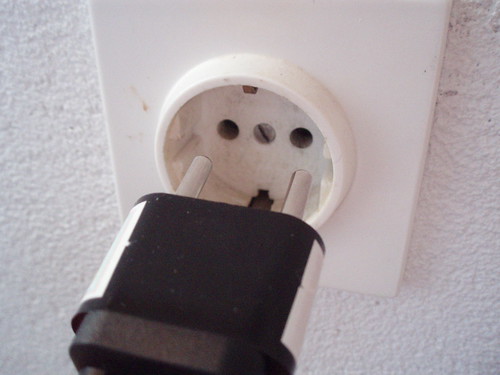
The power supply in France is 230V/50Hz. You might require an adaptor for the round tow-pins sockets used in France unless your electronic appliance takes 100-240V. Otherwise, if you live in a country with 110V electricity –like US- make sure to bring an adapter with you. You also might need a transformer to be able to use your electrical appliances. The plugs are also different than the ones in the US, so you will need an adapter.
Obviously, you should carefully read the information on your electrical appliances –laptop, camera, so on –before you plug them anywhere.
French Currency
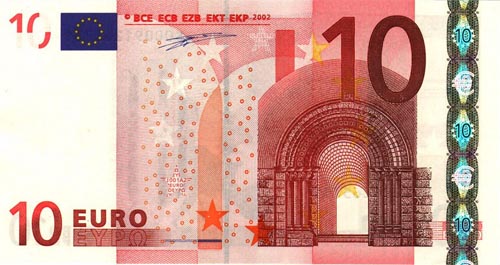
France uses the Euro (€). The banknotes are exactly the same all through the Euro area, although they show national French symbols on the back side. They come in seven denominations: 5, 10, 20, 50, 100, 200 and 500. Coins come in the following denominations: 1, 2, 5, 10, 20 and 50 centimes, as well as 1 and 2 euros. One face of the coins is common to all countries and the other face shows national symbols of France.
Check this conversion rate tool before planning your vacation.
Note: Restaurants and accommodations add a 10-15% service charge to every bill so leaving a tip is your call.
French Banks and ATMs
Credit and debit cards are the most convenient way to carry money around. They are quite safe as well. Visa and MasterCard are accepted pretty much anywhere. American Express is also accepted but not everywhere. Generally you can use your card in shops, supermarkets, road tolls, for train travel and to rent a car.
The cheapest way to change your money is via the ATM (DAB in France). You’d get the best exchange rate if you use your debit card at the ATM and your credit card when you purchase things.
Travelers’ cheques are also widely accepted, particularly in large towns and tourist centers. They are also safe to use and offer better exchange rate than cash.
The Weather in France
France has varied climates depending on where you are in the country. However, all of France definitely experiences distinct seasons. In most of the country, summers are warm or hot, falls and springs mild, and winter cold. Keep in mind however, that while you’ll get freezing temperatures and snow in the Alps, you’ll experience more moderate chilliness and grey skies in Paris in the winter.
Calling France, and Using the Telephone in France
The country code for France is 33. To call France from the U.S., you will first need to dial out of the U.S. and then into France – so that is 011-33 and then the phone number itself (dropping the initial “0”). All France numbers are 10 digits and start with “0”. To call to France from another European country, you will dial 00-33 and then the local number, or just +33 and the local number. To call a French number from within France, simply dial the local number as you have it. To call the U.S. from within France, dial 00-1 and then the area code and telephone number.
Most travelers prefer to use their mobile phones when they travel, which is easy (but expensive) if you activate the roaming feature with your service provider before leaving for vacation. France uses GSM 900/1800 mobile phones, a system that is compatible with the rest of Europe, but not with North America or Japan.
The network of public phones in France is vast although it’s been reduced because of the use of mobiles. The majority of public phones use cards. Cards can be purchased in a lot of places such as post offices, exchange offices, etc. Some public phones also accept credit cards but it costs more than using the local telephone cards.
If you prefer to use a French phone and number while in France, you can purchase a cell phone with a pay-as-you-go account; just make sure to bring your passport with you as ID.
Emergency Number in France
Ambulance/police/fire: 112
French Visa Information
France is a member of the Schengen Accord area. EU Nationals (those from within the EU) do not need a visa to visit France. A visa is not required for citizens of the U.S., Irish Nationals, Canadians, Australians, and New Zealanders for a stay of up to three months. To find information on Embassies in France, go here.
>>Find additional France travel resources
>>Learn about cities and regions in France
>>Transportation to and within France is covered over here.
Photos: sacerdotal, sithuseo